Designing a Cozy Business Sim Without the Spreadsheets
Business sims have a reputation: menus inside menus, profit-and-loss statements, and the nagging feeling that you need a spreadsheet open next to the game. I wanted Venture Life to be the opposite: a cozy game about building a company from an empty room, where you always understand what's happening and why.
The catch is that a business game with fake economics feels hollow. If numbers go up whatever you do, there's no game. So the design problem was honest economics, explained simply. This post covers how Venture Life does it.
The setup
You pick a company (a Corner Café, a Tech Studio or an Urban Farm), create a founder and open the doors. The company runs continuously: customers arrive, staff produce and serve, equipment wears out. You make the calls: what to charge, who to hire, when to repair, and whether to take the bulk order that might sink you. Your goal is a valuation target you choose up front: $500K, $1M or $2.5M.
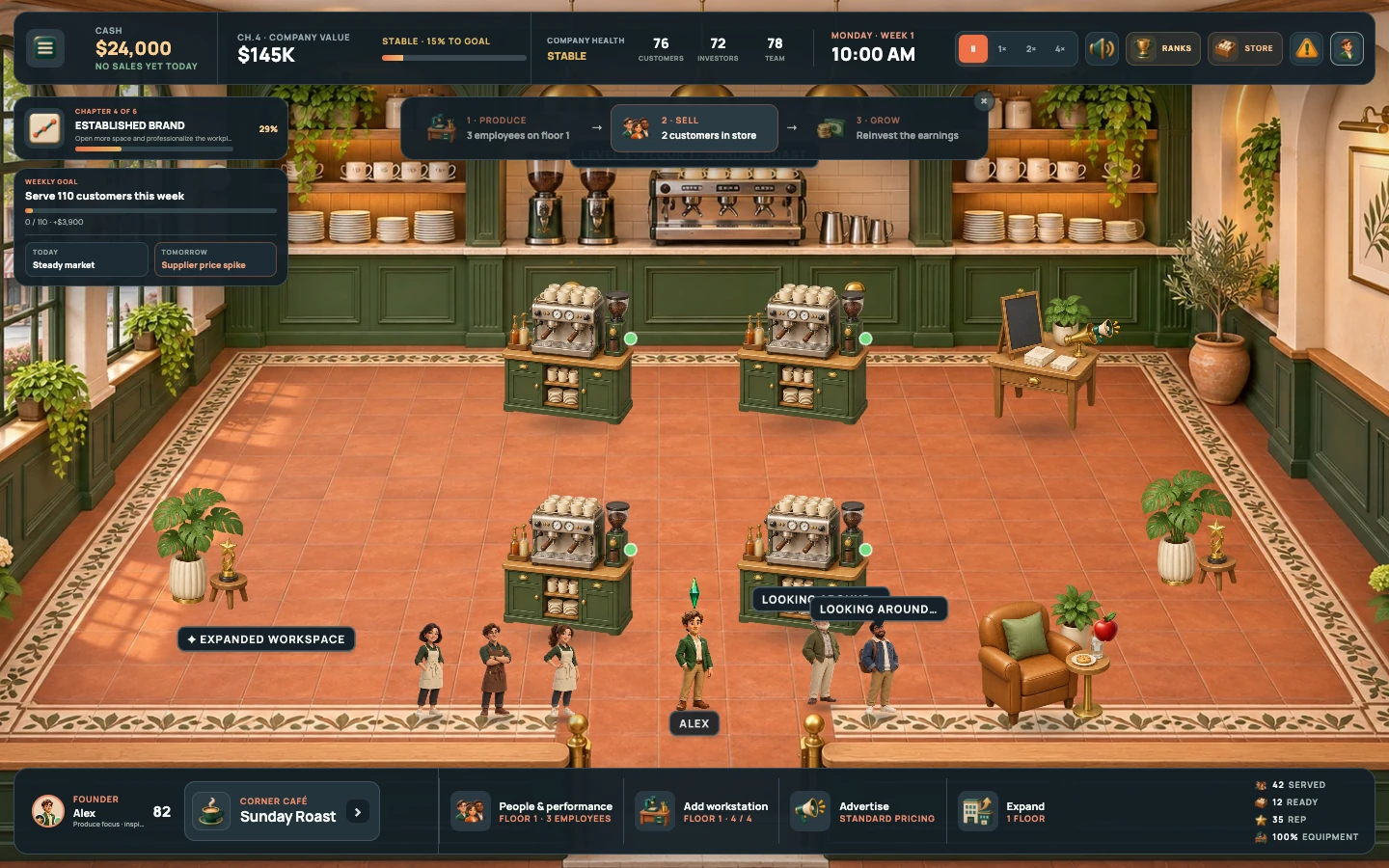
How much is the company worth?
Everything in the game feeds one number: company value. I based it loosely on how real small businesses are valued, which is mostly on what they earn:
// Company value is driven by earning power: the trailing five-day average
// retained profit capitalised at the industry multiple.
function earningsValue(business) {
  const cfg = BUSINESSES[business.type];
  const earnings = trailingProfit(business) * cfg.multiple * EARNINGS_MULTIPLE;
  return earnings < 0 ? earnings * 0.5 : earnings;
}
The full valuation adds up:
- Cash, minus any loan you owe
- Assets: your equipment, team and premises
- Earning power: your average profit over the last five days, times a multiple that depends on the industry (a tech studio is worth more per dollar of profit than a café)
- Track record and reputation: a little credit for lifetime revenue and goodwill
That total is then scaled by the company's health: customer happiness, investor confidence, team morale, and whether a disaster is in progress.
A few decisions here shaped how the game feels:
- Five days, not one. A single bad day dents your value but doesn't crater it. A bad week does. That gives you room to recover from mistakes without making them free.
- Losses count at half weight. A losing streak lowers your value, but not as fast as a winning streak raises it, so the game leans hopeful, as a cozy game should.
- Happiness and confidence multiply rather than add. You can't buy your way past unhappy customers: a company with great margins and angry customers is worth noticeably less.
One sentence at the end of every day
Players don't read formulas, so every day ends with a report that explains, in one sentence, why the value moved:
function profitDriverCopy({ profit, revenue, supplies, served, lost, delta, disaster }) {
  if (delta >= 0) return profit > 0
    ? `Profit of ${money(profit)} lifted the five-day earnings average.`
    : "Cash and assets held the value steady despite a weak day.";
  if (profit < 0) return "A losing day pulled the five-day earnings average down.";
  if (served > 0 && lost > served * 0.25) return `${lost} customers left without buying, cutting profit and trust.`;
  if (revenue > 0 && supplies > revenue * 0.4) return "Material costs ate most of the margin. Check pricing and production.";
  if (disaster) return "The active incident is weighing on value.";
  return "Earnings came in below recent days, so the five-day average slipped.";
}
The order matters: the checks run from most to least important, so you always get the explanation that matters most. And every sentence points at something you can act on: customers leaving (serve faster or hire), materials eating the margin (adjust pricing or production), an incident (deal with it).
This one function probably did more for how the game feels than any other system. A number going down is frustrating. A number going down with a reason you can fix is a challenge.
The same idea everywhere
Once the daily report worked, I used the same approach elsewhere. Staff at risk of quitting show exactly why:
happiness is 38% (safe at 45%) · 11 days since their last raise · shift load is 130%
Each reason tells you its own fix. Market events follow the same rule: every evening there's a forecast for tomorrow (busy streets, a festival, a rival's promotion, a supplier price spike), so you can prepare rather than react.
Choices that are actually choices
Cozy doesn't mean easy, and it doesn't mean there's always one right answer. The most interesting decisions in Venture Life are trade-offs:
- Pricing trades margin against demand and customer patience.
- Bulk orders pay a 55% premium if the full quantity is ready by closing. That means diverting your team from the customers in front of you, and a missed deadline hurts.
- Short loans let you grow faster but take a cut of every day until they're repaid.
- The IPO. Past your goal you can stay private, or sell 30% of the company to the public for a large injection of cash. Going public is irreversible: you're then paying out profit to shareholders, and their confidence becomes something you can lose.
After the goal
Reaching your valuation target doesn't end the game. It opens a franchise network on a world map, where each location is simulated with its own manager, costs and demand, and a portfolio, where you can start another company while the first keeps running in the background.
What I'd tell anyone designing a sim
- Base your numbers on something real, then simplify, rather than inventing arbitrary maths.
- Smooth the inputs (averages over days) so mistakes are recoverable.
- Explain every change in one sentence, and make the sentence actionable.
- Put the trade-offs in decisions, not in menus. Venture Life is free to play in your browser at venturelife.vercel.app.